
Go for Two to Win It?
Thursday night, Tulsa and North Texas were tied 38–38 after four quarters. In overtime, North Texas punched in a touchdown and kicked the extra point. Tulsa answered with a touchdown of its own, down 45–44, and the whole stadium knew the question: kick it and keep playing, or go for two and end it right now? Tulsa went for it. The pass failed. Game over. And here's the wild part: Tulsa made the exact same call in the exact same spot last year against Temple, and lost that one 38–37. So was it brave, or just bad math?
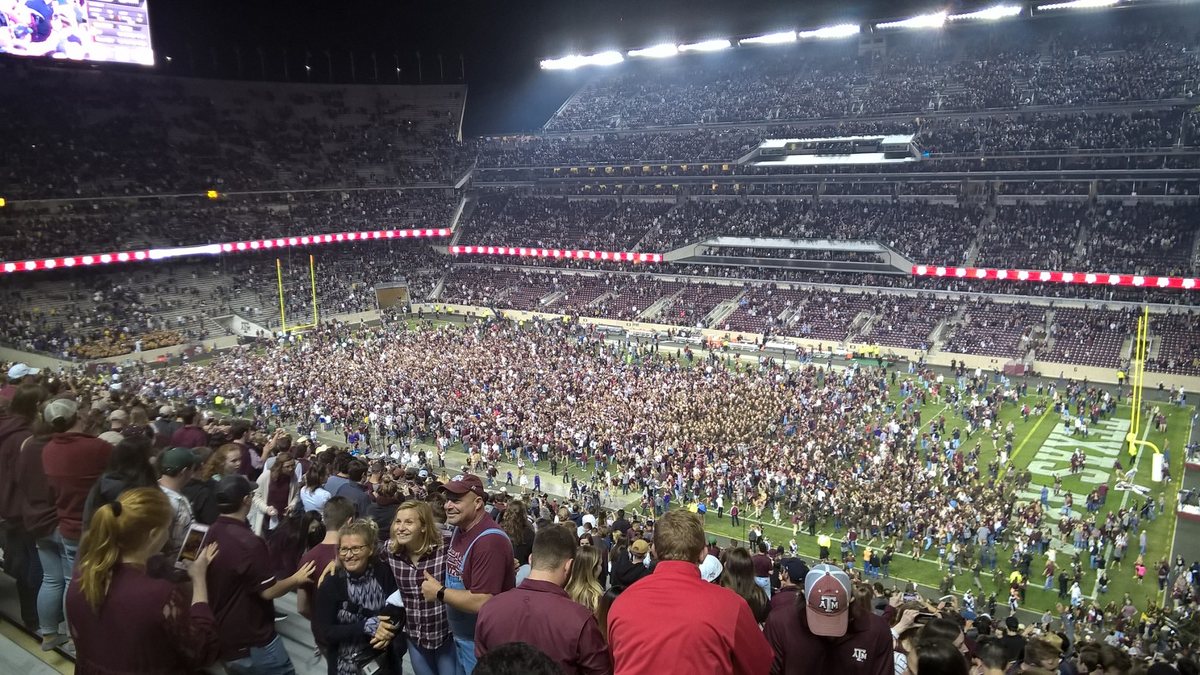

Wait, how does overtime work again?
College overtime in 30 seconds
Each team gets one possession starting at the other team's 25-yard line. Whoever has more points after both possessions wins. Still tied? Do it again, with the other team going first.
The twist is the try after a touchdown. In the first overtime, you can kick the extra point or go for two, same as always. In the second, you have to go for two. From the third on, there are no more drives at all: just one two-point play each, back and forth, like a penalty shootout in soccer.
That shootout rule is pretty new. After A&M and LSU played seven overtimes in 2018, the NCAA added shootouts starting in the fifth overtime in 2019, then moved them up to the third in 2021, all to keep games from turning into marathons.
So the big decision only exists in the first overtime. That's exactly where Tulsa was: the other team scored a touchdown and kicked, Tulsa scored a touchdown, and now it trails by one with a choice to make.
The whole decision in one line
If you go for two, you win right there if it works. So your chance of winning is just your chance of converting a two-point try.
If you kick, you need two things: make the kick (easy), and then win the second overtime, where you'll have the ball first. So your chance is kick chance × second-overtime chance.
That's it. Whichever number is bigger is the right call. Now we just need three numbers.
Number 1: how often does a two-pointer work?
You might think this is easy: count up every two-point try and see how many worked. But there's a catch. In a normal game, coaches pick when to go for two. They do it when they've got a play they love, or the defense looks gassed. Those tries work more often than a random one would, so they make two-pointers look easier than they are.
Overtime fixes that. In the second overtime, the rules force a two-point try after every touchdown, and the shootouts after that are nothing but two-point tries. Nobody chose those. We found 152 of them in overtime games with an FBS team since 2005, and 63 worked: 41.4%. (With only 152 plays, the real rate could reasonably be anywhere from about 33.9% to 49.4%.)

Number 2: the extra point
FBS kickers made 27,019 of 27,447 extra points from 2021 through 2025. That's 98.4%. Not much drama there.
Number 3: winning the second overtime
This is the tricky one. If you kick and tie, you get the ball first in the second overtime (the order flips every round; it did in 82 of the 85 games where we could check). So how often does the team that goes first in the second overtime win?
What actually happened: since 2021, 55 games reached a second overtime where we can tell who had the ball first. The team that went first won 36 of them, 65.5%. Going first turns out to be a nice spot: score a touchdown and a two-pointer, and the other team has to do both just to stay alive.
What a model says: 55 games isn't a lot, so we also built a simple model from 624 overtime rounds going back to 2005: how often the team going first scores a touchdown, a field goal or nothing, and how the second team responds when it knows what it needs. Run the second overtime through that, with forced two-point tries and a coin-flip shootout if it's still tied, and the team going first wins 46.6%.
Those two numbers don't agree, and honestly we can't tell you which one is closer to the truth yet. But here's the fun part: it doesn't matter, because kicking wins with either one.
Kick: 98.4% extra-point rate times the chance the team going first in the second overtime wins. Go for two: 41.4% of 152 overtime two-point tries nobody chose, 2005–2026.
What coaches actually did
Since 2021, 53 teams have been in Tulsa's exact spot: down one in the first overtime after scoring a touchdown. 39 kicked to tie, and 24 of those went on to win, 61.5%. Thirteen went for two. Three made it:
| Went for two and made it | Final |
|---|---|
| Missouri vs. Florida, 2021 | 24–23 |
| LSU vs. Alabama, 2022 | 32–31 |
| Western Kentucky at Louisiana Tech, 2025 | 28–27 |
The other ten got stopped, including Tulsa twice, plus Duke against SMU and Purdue against Illinois in 2024. (One more team, Miami (Ohio) at Kent State in 2021, failed its try too, but there's no play-by-play to tell us whether it was a missed kick or a stopped two-pointer.) That's 3 for 13, or 23.1%.
Is 3 for 13 proof that coaches are terrible at this? Not quite. Even a team with a normal 41.4% chance would go 3 for 13 or worse about 14% of the time, roughly 1 time in 7. Small samples can be cruel. But it sure doesn't help the case for going for it.
So when should you go for two?
Flip the math around. With an average two-point play, going for two is the right call only if your chance of winning the second overtime (going first) is below 42.1%. In other words, go for it when you think you'd probably lose a longer overtime: your defense is cooked, a key player is hurt, or the other team's offense has been unstoppable all night.
Or when your two-point play is a lot better than average. Here's how the edge moves. Each box is how many percentage points of win chance going for two gains (green) or costs (red) compared to kicking:
| Your two-point chance | 2nd OT: 40% | 50% | 60% | 65% |
|---|---|---|---|---|
| 40% | +0.6 | −9.2 | −19.1 | −24.0 |
| 45% | +5.6 | −4.2 | −14.1 | −19.0 |
| 50% | +10.6 | +0.8 | −9.1 | −14.0 |
| 55% | +15.6 | +5.8 | −4.1 | −9.0 |
| 60% | +20.6 | +10.8 | +0.9 | −4.0 |
Columns are your chance of winning the second overtime after a made kick. The real-world number since 2021 is about 65%; the model's is about 47%.
If the real number is anywhere near what's actually happened since 2021, you'd need a two-point play that works about 64% of the time just to break even. Almost nobody has that.
So, Tulsa?
Going for two in that spot isn't crazy. It's a defensible gamble, and it makes great TV. But on average it's the worse bet, and the history is rough: 3 for 13, with Tulsa now 0 for 2 on this exact call. Next time, Golden Hurricane, maybe just kick it and go win the second overtime. The numbers say you've got a good shot.
Update, Oct. 11: what about underdogs?
A question came in after this went up: does going for two make more sense for an underdog? Think about it. If you're the weaker team, a longer overtime gives the better team more chances to prove it. A single two-point play is over in about five seconds.
So we added how good each team looked before kickoff, using a team strength rating called Elo, to every overtime game since 2005. That's 709 games with a rating for both teams. Two things jumped out.
Being the better team helps in overtime, but only a little until the gap gets big.
| Underdog by | Overtime games | Underdog won |
|---|---|---|
| 0–3 points | 180 | 43.9% |
| 3–7 points | 202 | 45.0% |
| 7–14 points | 223 | 43.5% |
| 14+ points | 104 | 34.6% |
The two-point play barely cares who's better. On the 150 two-point plays nobody chose, underdogs converted 42.3% and favorites 40.5%. One play is close to a coin toss for anyone.
Put those together. As a team gets weaker, kicking (which means winning a whole extra overtime) loses value faster than going for two does. Using the model's estimate for the second overtime, going for two pulls ahead for teams expected to lose by more than about 7 points. But using what has actually happened since 2021, when the team going first in the second overtime won 65.5%, kicking still wins for anyone short of a 38-point underdog. Which is basically everybody.
Now the twist. By Elo, Tulsa was about a 14-point underdog against North Texas this year, and an 8-point underdog against Temple last year. That's right in the zone where going for two starts to make sense, if you trust the model. And coaches seem to know it: 11 of the 13 teams that went for two in this spot since 2021 were underdogs, by 9.2 points on average.
So: for a small underdog, kick. For a touchdown-plus underdog, going for two is a defensible gamble, maybe even the right one. Tulsa, we take back about half of what we said. (Small samples, and our two estimates for the second overtime disagree a lot, so nobody should be too sure here, us included.)
Data: line scores, drives and play-by-play for 741 overtime games with
an FBS team, 2005–2026, and FBS kicking stats for 2021–2025,
from CollegeFootballData.com. Some games' line scores lump several
overtimes together; those were left out. Who had the ball first comes
from each game's first overtime drive. Overtime rules:
NCAA (2021);
the 2019 shootout change after A&M–LSU:
Dallas Morning News.
The underdog update uses CFBD's pregame Elo ratings, converted to
points the same way as in our Baylor
post, and checked against the point spread where there is one. The full
analysis is in overtime_two_point.ipynb in the project.